
Introduction
Artificial intelligence is moving beyond drafting emails and summarising documents. In 2026, accounting platforms increasingly use AI to support transaction categorisation, document capture, reconciliation suggestions, invoice workflows, reporting and cash-flow insights. For small businesses, this creates an opportunity to reduce repetitive administration and obtain more timely financial information.
AI does not make bookkeeping accurate by itself. The quality of its output depends on source data, system configuration, business rules and review. The strongest approach combines automation for repeatable work with human judgement for exceptions and decisions.
What can AI help automate?
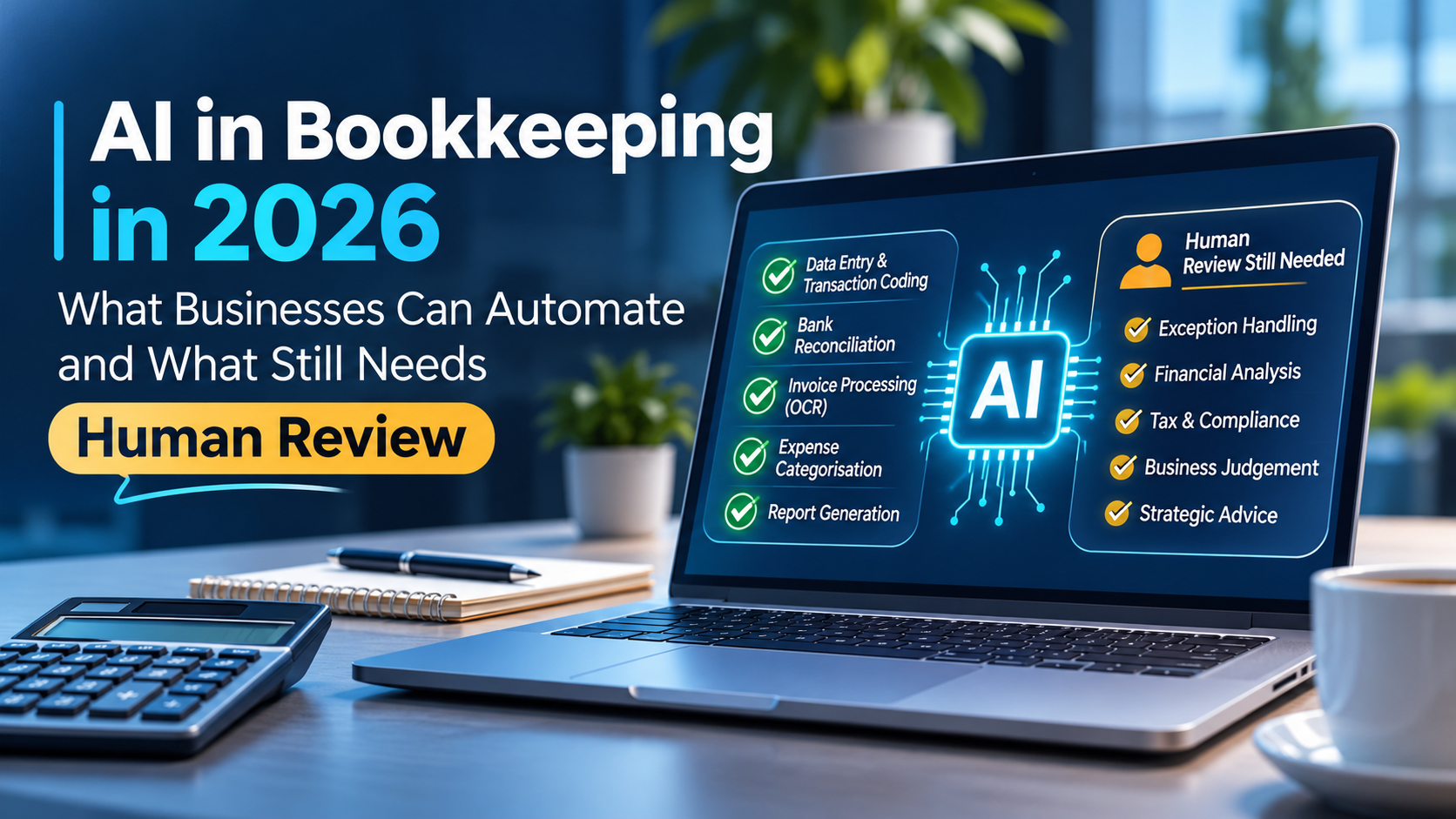
Depending on the platform and subscription, AI-enabled tools may assist with:
- Extracting information from invoices, bills and receipts.
- Suggesting account codes and matching transactions.
- Identifying unusual entries, duplicates or missing information.
- Drafting invoice reminders and routine finance communications.
- Summarising financial reports and highlighting movements.
- Supporting cash-flow forecasts and scenario questions.
Availability differs across products, countries and plan tiers. Businesses should verify what is actually enabled in their accounting system rather than assuming every advertised capability is available to them.
Where human review remains essential
AI suggestions can be wrong, incomplete or based on misleading patterns. A supplier payment may be unusual but legitimate; a transaction that looks recurring may have changed purpose; a receipt may contain ambiguous tax information. Human review is particularly important for unusual transactions, journals, payroll, tax treatment, related-party activity, period-end adjustments and decisions with material financial consequences.
A useful control is to set review thresholds. Low-risk, familiar transactions may follow approved rules, while high-value, unusual or sensitive transactions are routed to an authorised person.
Prepare your books before adding AI
AI performs better when the underlying accounting file is organised. Review the chart of accounts, supplier and customer records, opening balances, bank connections and historical unreconciled items. Establish consistent naming, document retention and transaction coding rules. Poor-quality data can make automated outputs appear confident while remaining unreliable.
A practical implementation roadmap
1. Select one repetitive process, such as receipt capture or bank transaction coding.
2. Document the current process and common exceptions.
3. Test the automation on a limited period or sample.
4. Compare suggestions with source documents and approved accounting treatment.
5. Record errors, corrections and time saved.
6. Expand only after controls and staff training are in place.
Security and governance questions
Before connecting AI tools to financial data, confirm what data is shared, who can access it, how access can be revoked, whether data is retained, and whether the vendor's terms meet your confidentiality obligations. Use named user accounts, least-privilege permissions and multi-factor authentication where available. Never share passwords or sensitive client records in unapproved public tools.
FAQs
### Will AI replace bookkeepers?
AI is more likely to change the work mix than remove the need for accountable finance professionals. Routine processing can be automated, while review, exception handling, controls and interpretation remain important.
### Can AI reconcile every bank transaction accurately?
No. Matching suggestions require review, especially for transfers, split payments, refunds, fees and transactions without clear references.
### Where should a small business start?
Start with a low-risk, repetitive task and measure accuracy as well as time saved. Do not automate a process that is not understood or documented.
How ACCIT BPO can help
ACCIT BPO supports businesses with bookkeeping, reconciliations, accounting software workflows and reporting. We help clients improve the underlying processes that make automation more reliable.
**CTA:** Contact ACCIT BPO to discuss practical bookkeeping automation and review controls for your business.