
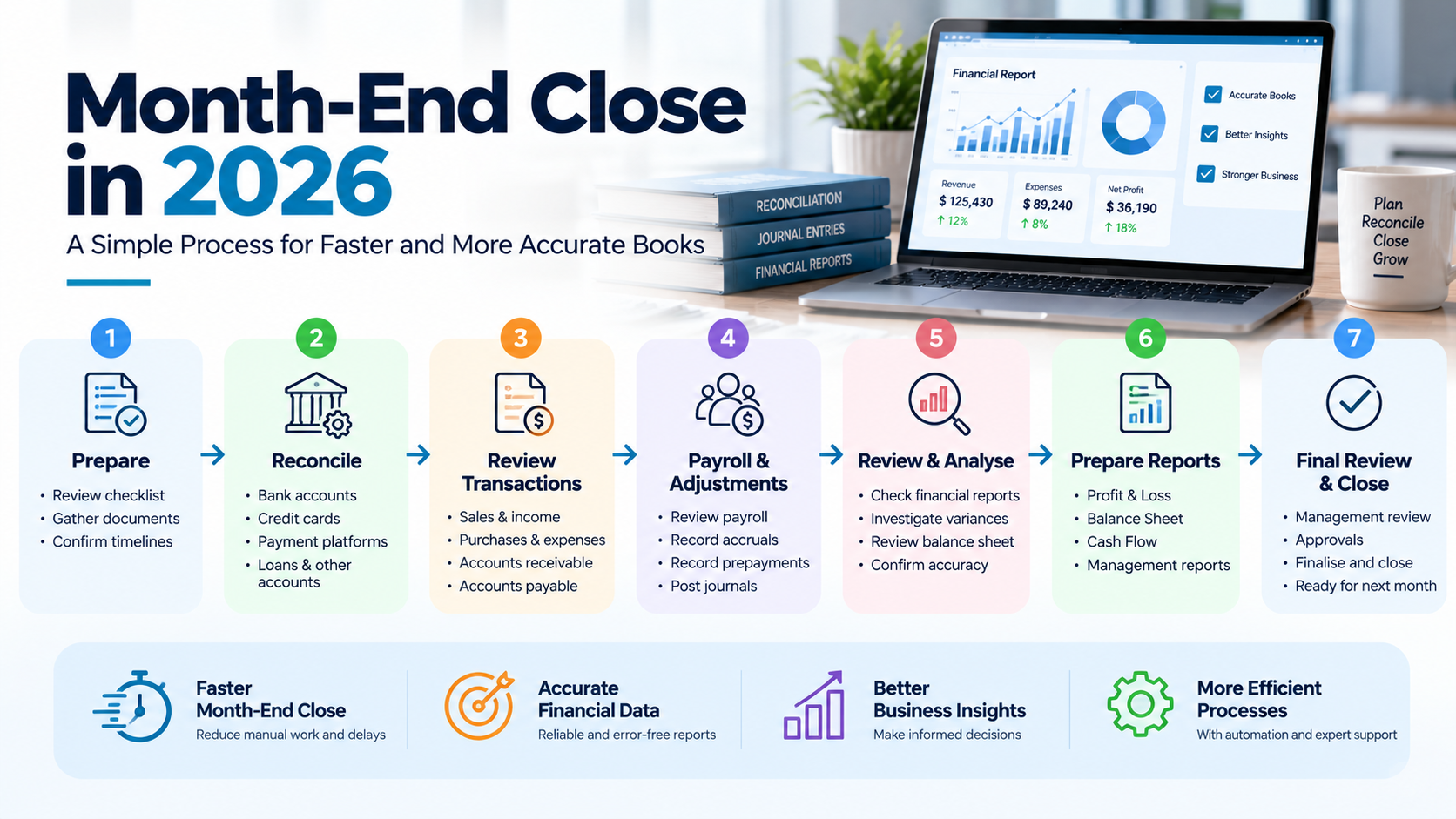
Month-End Close in 2026: How Businesses Can Close Their Books Faster and More Accurately
For many businesses, the end of the month brings the same challenge: closing the books accurately while getting financial information to management quickly.
Bank accounts need to be reconciled, invoices and expenses reviewed, payroll checked, accruals recorded, and financial reports prepared. When these activities depend heavily on spreadsheets, emails and manual follow-ups, the month-end close can become slow and stressful.
A well-designed month-end close process can make the process more predictable, efficient and accurate.
In 2026, businesses are increasingly combining cloud accounting, automation, standardised workflows and professional bookkeeping support to improve the speed and reliability of their monthly close.
What Is a Month-End Close?
Month-end close is the process of completing and reviewing accounting activities for a particular month so that a business can produce reliable financial statements.
A typical month-end close includes:
Recording all relevant transactions
Reconciling bank and credit-card accounts
Reviewing accounts receivable
Reviewing accounts payable
Checking payroll transactions
Recording accruals and prepayments
Reviewing fixed assets
Reconciling balance-sheet accounts
Reviewing unusual transactions
Completing adjusting journal entries
Reviewing the Profit & Loss
Reviewing the Balance Sheet
Preparing management reports
The objective is not simply to finish the bookkeeping.
The objective is to ensure that financial information is complete, accurate and useful for decision-making.
Why Does Month-End Close Take So Long?
A slow month-end close is often caused by several small issues rather than one major problem.
1. Bank Reconciliations Are Performed Too Late
If bank transactions are allowed to accumulate until the end of the month, the finance team has a large volume of transactions to review at once.
Regular reconciliation throughout the month can significantly reduce the workload remaining at month-end.
2. Missing Documentation
Invoices, receipts, expense claims and supporting documents may be stored across emails, cloud storage and different systems.
This can create delays when the accounting team needs to verify transactions.
3. Manual Data Entry
Repeatedly entering information between accounting software, spreadsheets and other systems creates additional work and increases the possibility of errors.
4. Unclear Responsibilities
If nobody clearly knows who is responsible for a particular reconciliation, journal entry or approval, tasks can remain incomplete until someone follows up.
5. Errors Are Discovered Too Late
A transaction recorded incorrectly during the month may only be identified during the final review.
This creates rework and can delay the entire close process.
6. Waiting for Information
Finance teams often depend on sales, operations, payroll, purchasing or management before completing certain accounting activities.
Without clear deadlines and processes, these dependencies can slow down the close.
7 Ways to Make Your Month-End Close Faster
1. Reconcile Throughout the Month
Don't wait until the final day of the month.
Where practical, reconcile:
Bank accounts
Credit cards
Payment platforms
Loans
Accounts receivable
Accounts payable
throughout the month.
This changes month-end from a large cleanup exercise into a final review and validation process.
2. Create a Standard Month-End Checklist
A standard checklist ensures that the same activities are completed every month.
For example:
Days 1–2
Complete bank reconciliations
Review payment gateways
Reconcile credit cards
Review outstanding invoices
Days 3–4
Review payroll
Post recurring journals
Record accruals
Review prepayments
Reconcile balance-sheet accounts
Day 5
Review Profit & Loss
Review Balance Sheet
Investigate significant variances
Complete management reporting
Obtain final review and approval
The exact timeline will depend on the size and complexity of the business, but having a defined process makes responsibilities and deadlines much clearer.
3. Automate Repetitive Accounting Tasks
Automation can reduce the amount of manual work involved in the month-end close.
Depending on the accounting system and business requirements, automation can assist with:
Bank feeds
Transaction matching
Recurring invoices
Recurring journals
Invoice processing
Payment matching
Reconciliation
Reporting
Task tracking
However, automation should support accounting professionals rather than eliminate appropriate review and judgement.
4. Standardise Your Accounting Procedures
A consistent process is easier to manage than a different process every month.
Create documented procedures for:
Bank Reconciliation → Accounts Payable → Accounts Receivable → Payroll → Journals → Balance-Sheet Reconciliation → Review → Reporting
This also makes it easier to train new team members and delegate responsibilities.
5. Investigate Unusual Variances
A faster close should not mean a less accurate close.
Once the accounts are reconciled, compare the current month with:
Previous month
Same month last year
Budget
Forecast
Look for significant changes in:
Revenue
Cost of sales
Gross profit
Payroll
Operating expenses
Accounts receivable
Accounts payable
Cash
A large variance isn't necessarily an error, but it should have an explanation.
6. Use Cloud Accounting Systems Effectively
Platforms such as Xero, QuickBooks Online and Zoho Books can help businesses centralise financial information and automate parts of the bookkeeping process.
But technology alone does not create accurate financial statements.
Clean data + correct processes + appropriate review = reliable reporting.
If the underlying bookkeeping is inaccurate, automation can simply make incorrect information available faster.
7. Consider Professional Bookkeeping Support
For growing businesses, month-end can become difficult when the internal team is already responsible for payroll, invoicing, collections, administration and other finance activities.
An external bookkeeping team can support specific parts of the process, including:
Bank reconciliation
Accounts payable
Accounts receivable
Transaction review
Cleanup and catch-up bookkeeping
Payroll support
Month-end close
Balance-sheet reconciliation
Management reporting
Accounting-system migrations
This allows internal finance teams and management to spend more time on analysis and decision-making rather than repetitive bookkeeping tasks.
The Role of AI in Month-End Close
One of the biggest changes in accounting in 2026 is the increasing use of AI and automation.
AI-enabled tools can help with:
Identifying unusual transactions
Matching transactions
Extracting information from documents
Categorising transactions
Monitoring outstanding tasks
Highlighting potential reconciliation issues
Supporting financial analysis
However, businesses should establish appropriate controls around automated accounting processes.
Human review remains important for transactions involving judgement, unusual circumstances, accounting policies and final financial approval.
The emerging approach is therefore not simply "AI instead of accountants."
It is:
Automation for repetitive work + accountants for judgement and review.
What Should a Good Month-End Close Deliver?
At the end of the process, management should have access to reliable financial information.
Profit & Loss
Understand revenue, cost of sales, operating expenses and profitability.
Balance Sheet
Understand cash, receivables, payables, liabilities and assets.
Cash Flow
Understand where cash is coming from and where it is being spent.
Variance Analysis
Understand why financial results changed compared with previous periods or budgets.
Management Reporting
Give decision-makers the information they need to plan the next month.
Month-End Close Checklist
Businesses can use this checklist every month:
☐ Bank accounts reconciled
☐ Credit cards reconciled
☐ Payment gateways reconciled
☐ Accounts receivable reviewed
☐ Accounts payable reviewed
☐ Payroll reviewed
☐ Inventory reviewed, where applicable
☐ Fixed assets reviewed
☐ Accruals recorded
☐ Prepayments reviewed
☐ Balance-sheet accounts reconciled
☐ Unusual transactions investigated
☐ Profit & Loss reviewed
☐ Balance Sheet reviewed
☐ Variances analysed
☐ Management reports prepared
☐ Final review completed
How ACCIT BPO Can Support Your Month-End Close
At ACCIT BPO, we help businesses and accounting firms manage their bookkeeping and month-end accounting requirements.
Our team works with clients globally and provides support across:
✔ Monthly bookkeeping
✔ Bank & credit-card reconciliation
✔ Accounts payable & receivable
✔ Month-end close support
✔ Bookkeeping cleanup & catch-up
✔ Payroll support
✔ Financial reporting
✔ Xero
✔ QuickBooks Online & Desktop
✔ Zoho Books
✔ MYOB & Sage
✔ Accounting-system migrations
✔ E-commerce bookkeeping
We can also work as an extended bookkeeping team for accounting firms, providing recurring or overflow support while the firm maintains its client relationships.
Ready to Improve Your Month-End Close?
A faster close isn't simply about working harder at the end of the month.
It's about building a repeatable process, maintaining clean financial data, using technology effectively and having the right people reviewing the numbers.
Need support with your bookkeeping or month-end close? Contact ACCIT BPO to discuss your requirements.