
Running a business requires constant attention to customers, employees, sales and growth. But bookkeeping can quickly become time-consuming when business owners have to manage transactions, invoices, expenses and reconciliations themselves.
This is where virtual bookkeeping services can make a significant difference.
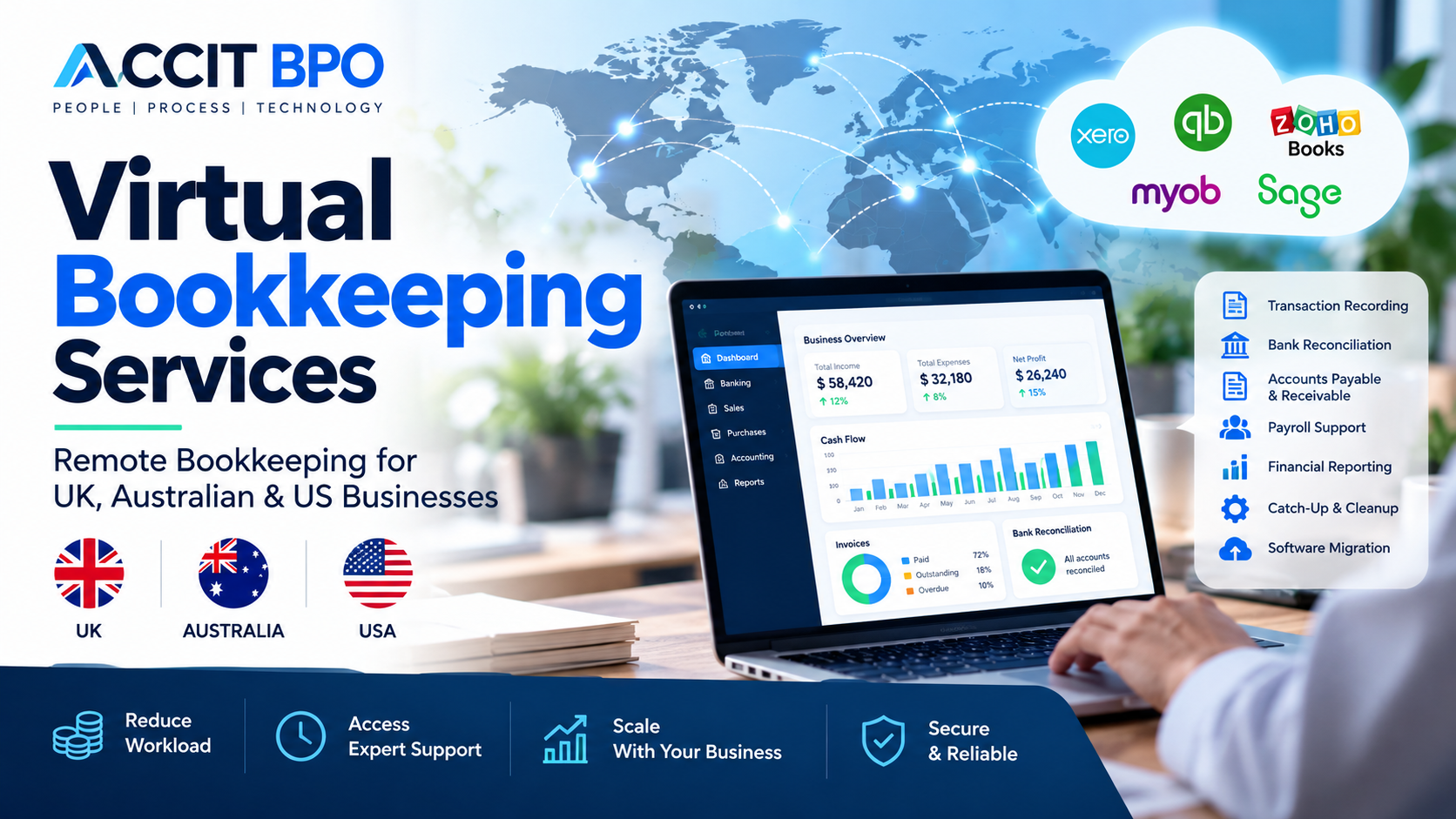
Instead of hiring a full-time bookkeeper to work from your office, businesses can work with an experienced remote bookkeeping team using cloud accounting platforms such as Xero, QuickBooks, Zoho Books, MYOB and Sage.
Today, businesses across the UK, Australia and the United States are increasingly using remote bookkeeping to maintain accurate financial records while reducing administrative workload.
But how does virtual bookkeeping actually work?
Let's explore.
What Is Virtual Bookkeeping?
Virtual bookkeeping is the process of managing a business's bookkeeping remotely using cloud-based accounting software and digital communication tools.
Instead of working from the client's physical office, the bookkeeper accesses the accounting system securely online and performs the required bookkeeping tasks remotely.
Depending on the business requirements, virtual bookkeeping can include:
• Recording income and expenses
• Bank and credit card reconciliation
• Accounts payable
• Accounts receivable
• Invoice processing
• Expense management
• Payroll bookkeeping
• Journal entries
• Month-end bookkeeping
• Financial reporting
• Catch-up and cleanup bookkeeping
• Accounting software setup
• Accounting software migration
• Management reporting
The business retains access to its financial information while the bookkeeping team handles the day-to-day accounting workload.
How Does Remote Bookkeeping Work?
A professional virtual bookkeeping arrangement usually follows a simple process.
1. Initial Consultation
The first step is understanding the business and its bookkeeping requirements.
A bookkeeping provider will normally review:
• Business structure
• Industry
• Accounting software
• Number of bank accounts
• Transaction volume
• Payroll requirements
• Existing bookkeeping processes
• Current financial records
• Reporting requirements
This allows the bookkeeping team to determine what needs to be done and how frequently.
2. Secure Access to Accounting Software
The client provides appropriate access to the accounting platform.
For example:
UK businesses: Xero, QuickBooks, Sage and other cloud accounting platforms.
Australian businesses: Xero, MYOB, QuickBooks and other accounting systems.
US businesses: QuickBooks Online, Xero, Zoho Books and other cloud platforms.
The remote bookkeeper can then work directly within the client's existing accounting environment.
3. Documents Are Shared Digitally
Invoices, receipts, bank statements and other financial documents can be shared electronically.
Businesses may use:
• Dext
• Hubdoc
• AutoEntry
• Google Drive
• Microsoft OneDrive
• Secure client portals
• Accounting software document systems
This reduces paperwork and makes financial information easier to access.
4. Transactions Are Recorded and Categorised
The bookkeeping team processes financial transactions according to the agreed chart of accounts and accounting procedures.
This may include:
• Sales transactions
• Supplier invoices
• Operating expenses
• Customer receipts
• Supplier payments
• Bank transactions
• Credit card transactions
• Payroll entries
The objective is to ensure transactions are correctly recorded and classified.
5. Bank Reconciliation
Bank reconciliation is one of the most important parts of regular bookkeeping.
The bookkeeper compares accounting records against bank and credit card transactions to identify:
• Missing transactions
• Duplicate entries
• Incorrect classifications
• Unmatched payments
• Unreconciled balances
Regular reconciliation helps businesses maintain reliable financial records.
6. Monthly Review and Reporting
Once bookkeeping is completed, the accounts can be reviewed and monthly financial reports prepared.
Typical reports include:
• Profit & Loss Statement
• Balance Sheet
• Cash Flow Statement
• Accounts Receivable Aging
• Accounts Payable Aging
• Expense Reports
• Management Reports
This gives business owners better visibility into their financial performance.
Virtual Bookkeeping for UK Businesses
UK businesses can benefit from virtual bookkeeping because cloud accounting platforms allow business owners, accountants and remote bookkeeping teams to collaborate efficiently.
Virtual bookkeeping can support:
• Small businesses
• Limited companies
• Startups
• Consultants
• Agencies
• E-commerce businesses
• Property businesses
• Professional services firms
A remote bookkeeping team can maintain day-to-day financial records while supporting processes related to VAT, management reporting and year-end accounting.
Businesses using Xero, QuickBooks, Sage and other cloud accounting platforms can collaborate with remote bookkeeping teams without requiring an in-office bookkeeper.
Virtual Bookkeeping for Australian Businesses
Australian businesses are also well suited to remote bookkeeping because cloud accounting platforms allow businesses and bookkeeping professionals to collaborate from different locations.
Popular platforms include:
• Xero
• MYOB
• QuickBooks
• Zoho Books
Virtual bookkeeping services for Australian businesses may include:
• Bank reconciliation
• Accounts payable
• Accounts receivable
• Payroll bookkeeping
• Financial reporting
• BAS preparation support
• Management reporting
• Catch-up bookkeeping
• Accounting software migration
For businesses requiring BAS preparation or lodgement, it is important to ensure that the person responsible has the appropriate Australian registration and authority where required.
Virtual Bookkeeping for US Businesses
US businesses can also benefit significantly from remote bookkeeping.
A virtual bookkeeping team can work within platforms such as QuickBooks Online, Xero and Zoho Books to manage day-to-day accounting.
Common services include:
• Transaction categorisation
• Bank reconciliation
• Credit card reconciliation
• Accounts payable
• Accounts receivable
• Payroll bookkeeping
• Month-end closing
• Financial reporting
• Cleanup bookkeeping
• Catch-up bookkeeping
Virtual bookkeeping allows US business owners to access professional bookkeeping support without maintaining a full-time bookkeeping position internally.
Virtual Bookkeeping vs In-House Bookkeeping
One of the biggest questions businesses ask is:
Should I hire an in-house bookkeeper or outsource bookkeeping?
There is no single answer for every business. However, virtual bookkeeping can provide several advantages.
In-House Bookkeeping Virtual Bookkeeping
Employee recruitment required No full-time recruitment required
Salary and benefits Flexible service arrangement
Office resources may be required Remote delivery
Training and supervision Experienced bookkeeping team
Capacity can be limited Easier to scale
Employee absence can affect workflow Team-based continuity
Fixed staffing cost Can be structured around workload
The right choice depends on transaction volume, complexity, internal resources and the level of financial support required.
Benefits of Virtual Bookkeeping
Reduce Administrative Workload
Business owners can spend less time entering transactions, matching payments and reconciling accounts.
Access Experienced Professionals
Businesses can work with bookkeeping professionals who have experience across different accounting platforms and industries.
Improve Financial Visibility
Regular bookkeeping means financial reports can be available when management needs them.
Scale With Your Business
Bookkeeping support can increase as transaction volumes and financial complexity grow.
Work Remotely
Business owners and bookkeeping teams can collaborate from different locations.
Reduce Spreadsheet Dependency
Cloud accounting systems allow financial information to be maintained in a central environment.
Support Better Decision-Making
Accurate and up-to-date bookkeeping provides the foundation for meaningful financial analysis.
Is Virtual Bookkeeping Secure?
Security should be an important consideration when selecting a remote bookkeeping provider.
A professional provider should use appropriate controls such as:
• Secure cloud accounting platforms
• Individual user accounts
• Multi-factor authentication
• Role-based access
• Password security
• Limited system permissions
• Secure document sharing
• Access monitoring
• Confidentiality agreements
• Regular access reviews
Businesses should also avoid sharing one username and password among multiple users.
Where possible, each user should have individual access with appropriate permissions.
Can a Virtual Bookkeeper Work With My Existing Accountant?
Yes.
In fact, this can be one of the most effective ways to use virtual bookkeeping.
A typical structure can look like:
Business Owner → Virtual Bookkeeping Team → Accountant / CPA
The bookkeeping team maintains day-to-day financial records, while the accountant focuses on areas such as:
• Tax
• Compliance
• Financial statements
• Advisory
• Planning
• Business strategy
For accounting firms, virtual bookkeeping can also provide additional production capacity without immediately requiring additional in-house recruitment.
Who Should Consider Virtual Bookkeeping?
Virtual bookkeeping can be particularly useful for:
Small Businesses
Businesses that don't require a full-time bookkeeper.
Growing Businesses
Companies where transaction volumes are increasing faster than internal resources.
Startups
Businesses that want professional financial records from the beginning.
E-commerce Businesses
Companies managing multiple sales channels and payment platforms.
Professional Service Businesses
Consultants, agencies, technology companies and other service businesses.
Businesses With Bookkeeping Backlogs
Companies that need catch-up or cleanup bookkeeping before moving to ongoing monthly bookkeeping.
Accounting Firms
Accounting practices that need additional capacity for recurring bookkeeping, overflow work or white-label back-office support.
How Much Does Virtual Bookkeeping Cost?
There is no single price for virtual bookkeeping.
Pricing can depend on:
• Number of transactions
• Number of bank accounts
• Number of entities
• Payroll requirements
• Accounts payable and receivable volume
• Reporting requirements
• Accounting software
• Historical cleanup requirements
• Industry complexity
• Frequency of bookkeeping
Some businesses require basic monthly bookkeeping, while others need a comprehensive finance function.
A customised quote is therefore usually more appropriate than a standard package.
Why Choose ACCIT BPO for Virtual Bookkeeping?
At ACCIT BPO, we provide remote bookkeeping and accounting support for businesses and accounting professionals across international markets.
Our team works with cloud accounting platforms including:
Xero | QuickBooks | Zoho Books | MYOB | Sage | SAP
Our services can include:
• Monthly bookkeeping
• Bank reconciliation
• Accounts payable
• Accounts receivable
• Payroll support
• Catch-up bookkeeping
• Bookkeeping cleanup
• Accounting software migration
• Financial reporting
• Management accounting support
• Data migration
• Accounting system support
We can also work as an extension of an existing accounting or bookkeeping practice, supporting recurring work and overflow requirements behind the scenes.
Our objective is simple:
Accurate books. Reliable processes. Better financial visibility.
The Future of Bookkeeping Is Remote, Cloud-Based and Technology-Driven
Virtual bookkeeping is no longer simply an alternative to having someone sit in an office.
Cloud accounting, automation and AI are changing how financial information is processed and reviewed.
Businesses can collaborate with bookkeeping professionals across geographical boundaries while maintaining access to their financial information through cloud-based systems.
The most effective approach is about combining:
Cloud Accounting + Automation + Experienced Bookkeepers + Human Review
to create a more efficient financial workflow.
Looking for Virtual Bookkeeping Support?
If your business needs reliable remote bookkeeping support in the UK, Australia or US, ACCIT BPO can help.
Whether you need ongoing monthly bookkeeping, bookkeeping cleanup, catch-up work, accounting software migration or additional bookkeeping capacity, our team can work with your existing systems and processes.
Contact ACCIT BPO today to discuss your bookkeeping requirements.